 +44 800 8611 208
The compliance blind spot hiding in your campaign forms
The problem with compliance as a checklist
Many marketing teams operate under the assumption that their forms are compliant. They believe that a previous review, legal sign-off on consent language, a working privacy policy link, and the inclusion of a GDPR disclaimer are sufficient. Once the form is live and the campaign is running, the general silence is often taken as confirmation that no issues exist.
The issue is that compliance isn't a static achievement; it's a dynamic state that brings significant risk, as most enterprise organisations lack the necessary infrastructure to continuously monitor and assess the compliance status across their entire estate of forms.
By the time a compliance issue surfaces, whether it be during an audit, via a data subject complaint, or through a regulatory inquiry, the gap between what the form was supposed to capture and what it actually captured has often been open for months. The consent was invalid, the opt-in wording was ambiguous, the regional disclaimer that applied to Polish users was never added, or the forms were cloned from an older template that pre-dated a policy update, and nobody checked whether the clones inherited the problem.
These are not hypothetical scenarios but real patterns that emerge when consent management is treated as a design decision rather than a governed process.
Why B2B teams underestimate the risk
There is a persistent assumption in B2B marketing that GDPR and data privacy regulations are primarily a consumer concern. The rationale is that our professional audience anticipates our communications, placing business-to-business interaction in a separate category. Regulators across Europe have been explicit that this assumption is not the case. If the data relates to an identifiable person, which any lead record does, the same rules apply. The B2B context does not reduce the obligation to capture valid, documented consent.
Major B2B organisations have been penalised in recent years specifically for failures in consent capture: pre-ticked opt-in boxes, vague or bundled consent language that conflated marketing permissions with product terms, missing proof of consent when challenged, and third-party lead data used without verification of how it was originally collected. Each of these failures traces back to the same root: forms that were built to convert, not to comply.
We see the risk compounding in global teams. Different countries maintain different standards within and beyond GDPR, and what constitutes a valid opt-in in Germany differs from the requirements in France, Poland, or markets in Scandinavia. A form deployed across multiple regions with a single, static consent block is almost certainly non-compliant in some of them – it is just that no one has confirmed which ones or when.
The form estate no one is auditing
One of the most common responses when compliance questions arise is to conduct a form audit. Marketing operations pulls together a list of active forms, checks the consent fields, reviews the opt-in language, and updates anything that looks out of date.
The problem is that most organisations cannot accurately answer the question that makes this exercise possible: how many lead capture forms do we currently have live, and where are they deployed?
Forms proliferate in enterprise marketing environments: a campaign goes live, and a form is built, or a regional team needs a localised version, so the form is cloned and translated. A product launch adds three more forms, or a microsite goes up with its own form, separate from the main platform. Over time, the form estate grows across campaign landing pages, blog posts, event registration pages, embedded widgets, and third-party microsites – and no one retains a complete picture of them. Individual teams know their own forms, but no one owns the whole.
This is what makes forms a structural compliance risk rather than an isolated one. When a regulatory requirement changes, the question is not whether to update the affected forms but whether you know which forms are affected, can locate all of them across every system and deployment, and can make the change consistently without missing instances. In most organisations, the honest answer to all three is no.
What invalid consent actually looks like
Compliance failures in lead capture forms tend to take similar shapes. Pre-ticked consent boxes remain one of the most common, a clear violation under GDPR that still appears on forms built under time pressure without adequate review. Vague opt-in copy is another frequent issue: consent wording that does not clearly specify what the prospect is agreeing to or that bundles marketing permissions with acceptance of product terms in a single checkbox. Both are invalidated under the requirement for freely given, specific, and informed consent.
Consent that cannot be proved is a less visible but equally serious problem. When a data subject challenges whether they gave permission to be contacted, the burden is on the organisation to demonstrate that valid consent was captured – the specific wording shown at the time of submission, the date and method of capture, and the version of the privacy policy in effect. If distributed teams build and manage forms informally, they rarely create this audit trail. The consent happened, but there is no record of exactly what the person agreed to.
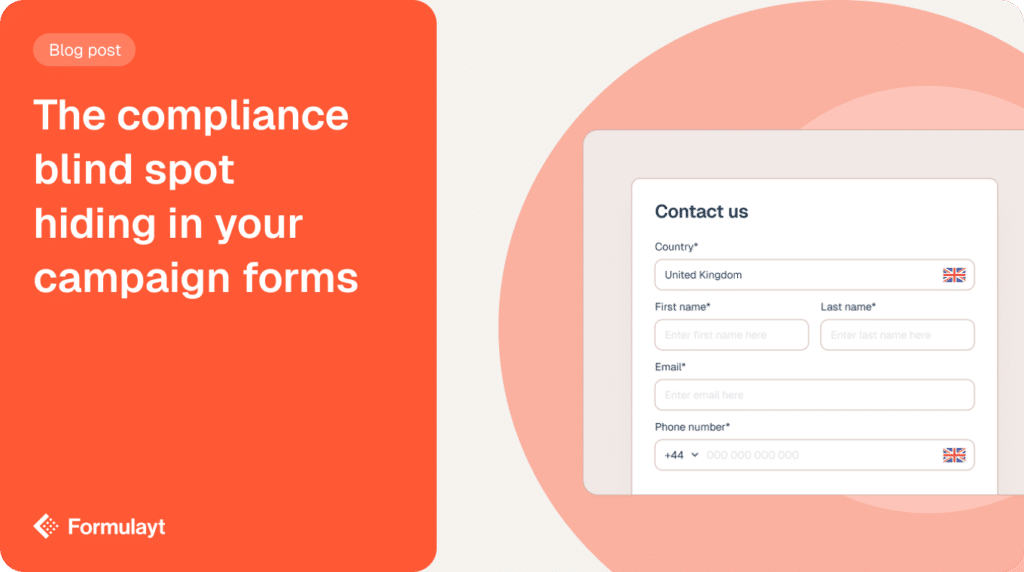
Regional compliance gaps are also common and particularly hard to detect. A form may be technically compliant for UK users while failing requirements for users in Germany, Poland, or markets that have introduced specific consent standards beyond the core GDPR framework. The correct approach is for consent logic to respond dynamically to the user's declared location, meaning that if a prospect indicates they are in a country with additional requirements, additional or different consent fields should appear. Achieving this objective through static form templates is not feasible, and achieving it consistently across hundreds of forms without a centralised system is also impossible.
The governance gap that makes this worse
The underlying problem in most organisations is not a lack of awareness of compliance obligations – it's the absence of any system that enforces compliance at the point of form creation and maintains it over time.
Marketing teams build forms under campaign pressure. Developers, who configure or modify forms, focus on delivery rather than regulatory detail. Legal review, where it exists at all, happens infrequently and inconsistently, and there is a sign-off on a new template that then gets cloned and modified without any subsequent review. Consent wording, disclaimer text, and opt-in logic are reproduced manually from form to form, with no guarantee that the version being copied is current.
This means that every new campaign introduces the possibility of a new compliance gap. The most recent policy update may not have reached the template being used, the approved opt-in wording may have been slightly edited to fit the page layout, or the regional rules that apply to this particular audience may not have been factored in at all. None of this information is visible in the moment. It only becomes visible when something goes wrong.
Compliance needs to be built into the system, not reviewed after the fact
The organisations that handle this aspect well have made a structural change by moving consent management from a campaign-level decision (something each team configures on each form) to a platform-level control that is applied automatically and consistently across every form, every campaign, and every region.
In practice, this approach means consent logic is defined centrally and cannot be overridden locally. Opt-in wording is managed in one place and propagates to every form that uses it, so a single update reaches the entire form estate immediately. Regional compliance rules are built into the system, triggered dynamically based on the user's declared location rather than relying on teams to configure the correct settings for each market. Every submission is accompanied by a documented record of the exact consent presented and captured — not reconstructed after the fact, but created at the point of submission.
This is the difference between managing compliance and trusting that compliance is happening. One creates a provable, consistent record across every touchpoint, and the other creates the appearance of compliance until something happens that enforces a closer look.
What to check in your own setup
If you are not certain of your organisation's position, some direct questions are worth asking.
- Can you produce a complete and accurate list of every active lead capture form across all campaigns, regions, and platforms?
- For each of those forms, can you confirm when the consent language was last reviewed and whether it reflects current requirements?
- If a country introduced a new consent requirement today, how long would it take to apply it across every affected form, and how would you know you had not missed any?
If those questions are difficult to answer, the compliance risk is already present, and it is not a future concern, just a current one that has not yet been exposed.
Where to start
Forms are where consent is created or lost. Everything downstream, like the contact record, the nurture flow, the outbound campaign, and the data held in the CRM, depends on whether that initial capture was valid. If the form infrastructure is not governed, the consent infrastructure is not governed either. And in the current regulatory environment, that is not a risk most organisations can afford to carry indefinitely.
If you want a clear view of how your consent and compliance settings operate across your form estate, we offer a free Lead Capture Governance Assessment
In a focused working session, we identify where consent language is inconsistent or out of date, where regional compliance requirements are not being met, and where the audit trail for consent is incomplete.
The objective is to give you a clear picture of where the risk sits before an external party finds it for you.