 +44 800 8611 208
Bad B2B data doesn’t start in your CRM. It starts at the form.
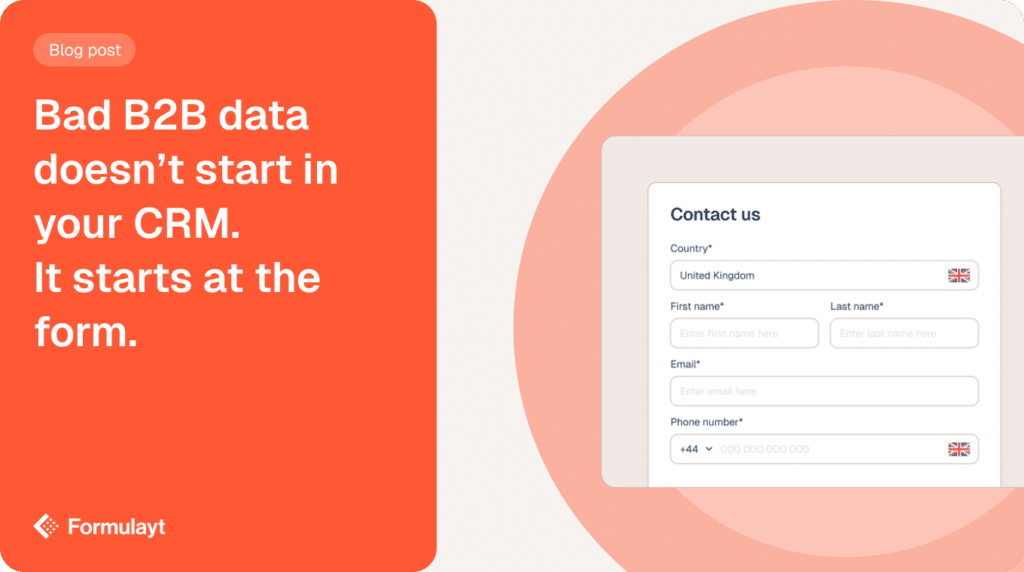
When first-party data quality becomes a problem, the instinct is to look at the tools holding the data. The CRM gets audited, the marketing automation platform gets reconfigured, the data cleansing scripts get written, or consultants get brought in to remap fields.
Months of effort and a significant cost later, the problem keeps coming back, and that's because the diagnosis is wrong.
Bad B2B data is rarely created inside your CRM or MAP – it's created the moment a prospect fills in a form, and nobody governed what that form was actually capturing.
The stack gets the blame. The form layer gets the pass.
Enterprise marketing teams invest heavily in downstream data infrastructure like Salesforce, Eloqua, Marketo, data warehouses, BI tools, and enrichment APIs, with the baked-in assumption that if these systems are sophisticated enough, data quality will follow – but it doesn't.
When a lead arrives in your CRM with an inconsistent job title, an unmapped industry value, or a country field that doesn't match your picklist, remember that the platform didn't create that problem. The form did; someone built it without referencing a data dictionary, a field was labelled differently from the one in the last campaign, or a dropdown offered options that didn't align with how Sales qualifies accounts. The platform accepted what it was given, which is precisely what it was designed to do.
What governs a field before it reaches the system?
For most enterprise teams, the honest answer is 'very little'.
A campaign manager needs a form for a new content asset, so they clone an existing one, adjust a few labels, remove a field that felt unnecessary, and push it live. No data steward reviewed it, no field naming standard was enforced, and no one checked whether the values that form would collect could actually be used by the automation downstream.
When you multiply this issue across a global marketing team that runs dozens of campaigns simultaneously, each with its own forms, interpretations of what data is important, and shortcuts, the root cause of your data quality problem becomes clear. This is a governance failure at the point of capture disguised as a systems failure.
The data in your CRM is only as reliable as the decisions made on the form before it got there.
The job title problem: a case in point
Ask ten marketing ops professionals what their single biggest data quality headache is, and a significant proportion will respond with one of a few of the following: job titles, free-text fields, inconsistent capitalisation, abbreviations versus full titles, regional variations, or sales ignoring records because the title doesn't match their ICP criteria.
The solution teams reach for is usually normalisation in the CRM, running data cleaning processes to map "Sr Marketing Mgr" to "Senior Marketing Manager" or deploying an enrichment tool to overwrite what was captured with something cleaner.
Both approaches treat a governance failure as a data management problem, but neither solves it at the source.
The correct fix is upstream: a controlled field with validated options, applied consistently across every form that asks for job function. When the field is governed at the point of capture, the data arrives clean. When it isn't, every downstream system is managing the consequences of an ungoverned input.
The same logic applies to company size, industry, country, and every other field your scoring and segmentation models depend on.
How ungoverned capture breaks scoring, segmentation, and AI
The consequences of poor capture governance compound the further downstream you go.
Lead scoring models require field values to be consistent to function, or a model built on "Company Size: 500-1000" breaks the moment a form returns "approx. 1k employees" for the same type of contact. Scoring either misfires or falls back to incomplete data, which means Sales receives leads ranked by guesswork rather than real signals.
Segmentation has the same dependency. Personalisation campaigns built on industry or persona data produce generic or irrelevant messaging when the underlying field values are inconsistent. Again, the personalisation engine isn't broken – it's working exactly as designed, but what it was given was not good enough.
AI models are particularly unforgiving here: predictive lead scoring, intent modelling, and AI-assisted qualification all require high-quality, standardised training data to produce reliable outputs. Garbage in, as the saying goes. When the capture layer is ungoverned, AI doesn't improve the situation; it accelerates and scales the problem.
The governance gap between form builder and data architect
In most enterprise marketing teams, the people who build forms and the people who design data schemas rarely speak to each other.
Campaign managers or field marketers who build the forms optimise for speed, conversion, and campaign delivery. Data architects or marketing ops leads who design the fields, picklists, and system integrations optimise for data integrity and downstream usability. Both groups are doing their jobs, but the problem is the gap between them.
Without a shared standard and a governed field library that defines exactly how each data point should be captured, what values are permitted, and how those values map to downstream systems, every form becomes a local decision. And local decisions, at enterprise scale, produce inconsistent data.
This is the discipline problem that underlies most first-party data quality failures: a shortage of enforced standards at the layer where data originates.
Start upstream, not downstream
If your data quality programme focuses primarily on what happens to data after it enters your stack, you're solving the right problem, but in the wrong place.
Cleaning data downstream is expensive, labour-intensive, and requires constant maintenance. An enrichment API will address symptoms, not causes, and that intensive CRM audit will only find out what went wrong after the fact. None of these investments reduce the volume of bad data arriving in your systems, because none of them govern the source.
The more durable fix starts at lead capture: a governed field library, standardised across every form in your estate. Validated input options that align with how your CRM and MAP store and use that data. A process that ensures new forms inherit those standards rather than diverge from them. Oversight that allows you to see, in one place, what data each active form is capturing and whether it conforms to the standard you've set.
When capture is governed, the data arrives in the right shape, and every downstream system benefits from it – scoring, segmentation, attribution, and AI included.
Think your first-party data problems might be originating earlier than you realised? Formulayt's free Lead Capture Governance Assessment helps B2B marketing teams identify exactly where governance breaks down before it reaches the CRM. Start your free assessment →